
Types of Heat Resistant Gloves: A Complete Guide to Thermal Hand Protection
Updated: Jul 31

Contact with a hot surface, molten metal, or an open flame can cause a serious burn in a fraction of a second — often before a worker has time to react. In foundries, welding bays, glass manufacturing units, and metal fabrication shops, hands are the part of the body most exposed to this risk, and standard work gloves offer little to no protection once temperatures climb. That's why heat resistant gloves are treated as essential, not optional, safety equipment across heat-intensive industries.
But heat resistant gloves aren't all built for the same level of exposure. A glove rated for brief contact with a warm surface is very different from one designed for sustained contact with molten metal or open flame. In this guide, we'll break down what makes a glove genuinely heat resistant, the real difference between single and double layer construction, and how to choose the right protection for your specific task.
This guide is for general product information. Always confirm suitability for your specific application against the product datasheet and your workplace's safety protocols before use.
What Makes a Glove Heat Resistant?
Heat resistant gloves are built from materials engineered to withstand high temperatures without breaking down, melting, or transferring heat quickly to the skin underneath. Delight's heat resistant range uses para aramid yarn, known for high heat resistance, strength, and durability, knitted into a seamless glove construction.
The key factor that determines how much heat a glove can handle isn't just the material, but how many layers of protection are built in:
Single layer construction provides reliable protection for moderate heat exposure, while staying lightweight and flexible for tasks needing more dexterity.
Double layer construction adds a second insulating layer, significantly increasing the temperature a glove can withstand, at the cost of some flexibility.
This single layer vs double layer distinction is the most important decision point when choosing a heat resistant glove — more important than color, grip pattern, or length.
A note on contact time: even a glove's stated temperature rating (e.g. "up to 250°C") refers to a tested exposure limit under specific EN 407 contact heat test conditions, not indefinite protection under all conditions. No glove is meant for prolonged, unbroken contact with molten metal — always follow the specific contact-time guidance in the product datasheet for your task.
Heat Resistant Gloves vs Regular Work Gloves
Aspect | Regular Gloves | Heat Resistant Gloves |
Heat protection | None or minimal | Engineered for sustained heat exposure |
Material | Cotton, leather, standard fabric | Para aramid yarn, heat-resistant knit |
Risk in high-heat tasks | Can scorch, melt, or fail suddenly | Designed to withstand direct heat contact |
Best suited for | General handling, light tasks | Welding, foundry work, glass handling, hot metal contact |
Standard gloves can fail without warning when exposed to heat they weren't designed for — the material can scorch, stiffen, or melt against the skin, which is often worse than having no glove at all. If your work involves any regular contact with high heat, a heat resistant glove is a different category of product entirely, not just a thicker version of a regular glove.
Types of Heat Resistant Gloves
Delight's heat resistant range is built around two core protection levels — single layer and double layer — with feature variants available within the single layer line.
1. Single Layer Para Aramid Gloves — Delight MHPK10
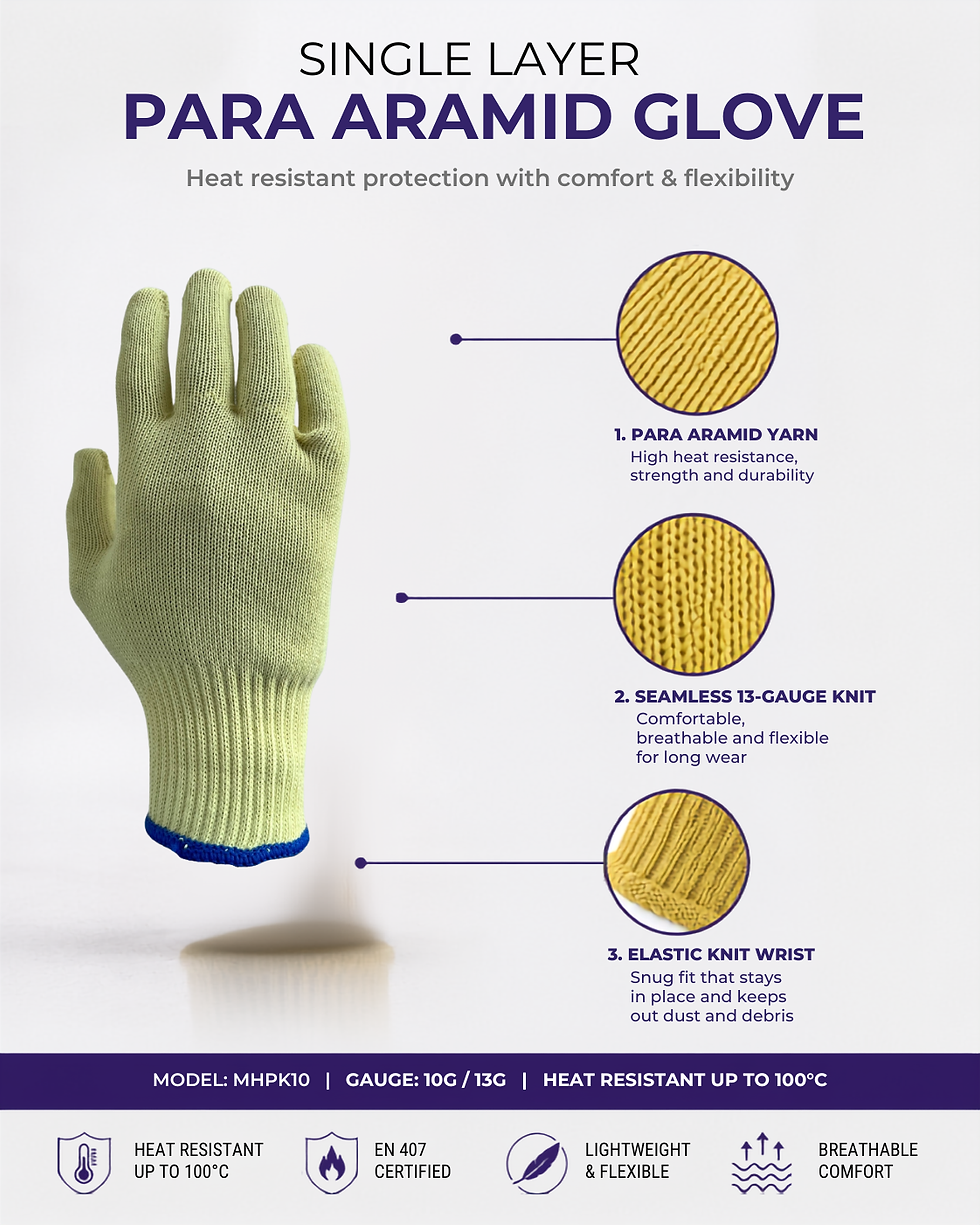
Construction: A seamless, 10-gauge knitted glove made entirely from para aramid yarn, available in four weight options (50g, 55g, 60g, and 70g).
How it works: The para aramid fiber itself resists heat and doesn't melt or ignite easily, so a single knitted layer is enough to handle moderate, everyday heat exposure while staying flexible.
Heat resistance: Tested to withstand up to 100°C under EN 407 contact heat testing — see datasheet.
Best for:
General handling of moderately hot components
Tasks needing good dexterity and flexibility
Repeated daily use in dry, heat-exposed environments
Limitations: Not rated for sustained direct contact with very high heat sources like molten metal or open flame — for that level of exposure, double layer protection is required.
2. Single Layer with Thumb Stretch — Delight MHPK10-55(T)

Construction: Same 10-gauge para aramid base as the MHPK10, with an added thumb stretch design for improved fit and range of motion.
How it works: The stretch panel at the thumb flexes with hand movement instead of resisting it, so precise or repetitive thumb motions don't fight the glove's fit.
Heat resistance: Tested to withstand up to 100°C under EN 407 contact heat testing — see datasheet.
Best for:
Tasks requiring more precise thumb movement, such as handling small hot components or fine positioning work
Users who found the standard fit restrictive during extended wear
3. Single Layer with PVC Dot Grip — Delight MPHD93-60

Construction: Aramid single layer glove with anti-slip PVC dots on the palm, available in 50g, 70g, and 80g weight options.
How it works: The raised PVC dots add friction exactly where the palm contacts a part, so smooth or slightly oily hot components stay secure without needing extra grip force.
Heat resistance: Suitable for moderate heat handling.
Best for:
Handling smooth or slightly oily hot components where extra grip prevents slipping
Tasks combining moderate heat exposure with a need for secure hold
4. Double Layer Para Aramid Gloves — Delight MPHD91-12

Construction: A double-layer glove combining a soft cotton inner layer with a para aramid outer layer, available in four length options (10", 12", 14", and 16") for extended wrist and forearm coverage.
How it works: The para aramid outer layer takes the direct heat contact while the cotton inner layer adds insulation and cushioning, together raising the safe contact threshold well above what a single layer can handle.
Heat resistance: Tested to withstand up to 250°C under EN 407 contact heat testing — see datasheet.
Best for:
Sustained contact with very hot surfaces, molten metal, or direct flame proximity
Foundry work, welding, and glass handling where maximum thermal protection is required
Tasks needing wrist or forearm coverage in addition to hand protection
Limitations: The added insulation layer means less dexterity than the single layer options — better suited to tasks where maximum heat protection matters more than fine motor control.
Size Chart for Heat Resistant Gloves
Glove | Model | Available Variants | Color |
Single Layer Para Aramid | MHPK10 | 50g / 55g / 60g / 70g weight options | Yellow |
Single Layer with Thumb Stretch | MHPK10-55(T) | 50g / 55g / 60g / 70g weight options | Yellow |
Single Layer with PVC Dot Grip | MPHD93-60 | 50g / 70g / 80g weight options | Yellow with Blue PVC dots |
Double Layer | MPHD91-12 | 10" / 12" / 14" / 16" length options | Yellow (outer) / Natural (inner) |
Custom weight, length, size, and logo printing are available on request — contact our team to confirm current stock for your required variant.
Weight & Layer Construction Comparison
Since heat resistant gloves don't use a coating like ESD gloves do, the equivalent differentiator here is layer construction and weight — this is what actually drives the protection-vs-dexterity trade-off:
Glove | Layer Construction | Weight | Dexterity |
MHPK10 | Single (para aramid) | 50g–70g (4 options) | High |
MHPK10-55(T) | Single (para aramid) + thumb stretch | 55g | High |
MPHD93-60 | Single (aramid) + PVC dot palm | 50g / 70g / 80g | Moderate–High |
MPHD91-12 | Double (cotton inner + para aramid outer) | Heavier — two-layer construction | Lower |
Single Layer vs Double Layer: Quick Comparison
Feature | MHPK10 | MHPK10-55(T) | MPHD93-60 | MPHD91-12 |
Heat resistance | Tested to 100°C under EN 407 | Tested to 100°C under EN 407 | Moderate heat handling | Tested to 250°C under EN 407 |
Layers | 1 (para aramid) | 1 (para aramid) + thumb stretch | 1 (aramid) + PVC dot palm | 2 (cotton inner + para aramid outer) |
Dexterity | Higher | Higher | Moderate–High | Lower |
Length options | Standard | Standard | Standard | 10" / 12" / 14" / 16" |
Best for | Moderate, repeated heat exposure | Fine thumb-precision tasks | Grip on smooth/oily hot parts | Sustained, high-intensity heat exposure |
Full Specifications Comparison
Feature | MHPK10 | MHPK10-55(T) | MPHD93 | MPHD91-12 |
Layer Type | Single | Single | Single | Double |
Yarn Material | Para Aramid | Para Aramid | Para Aramid | Cotton + Para Aramid |
Heat Resistance | Tested to 100°C (EN 407) | Tested to 100°C (EN 407) | Moderate heat handling* | Tested to 250°C (EN 407) |
Variant Options | 50g/55g/60g/70g | 50g/55g/60g/70g, thumb stretch | 50g/70g/80g, PVC dot grip | 10"/12"/14"/16" |
Reusability | Reusable | Reusable | Reusable | Reusable |
Standard | EN 407 | EN 407 | EN 407 | EN 407 |
*MPHD93's product page lists it as suitable for moderate heat handling rather than a specific numeric rating.
Where Heat Resistant Gloves Are Used: Real-World Applications
Delight manufactures its heat resistant glove range from our facility in Bhiwadi, Rajasthan, supplying businesses across foundry, welding, and metal fabrication sectors. Across the industry, double layer gloves are typically preferred wherever workers have sustained or direct contact with molten metal or flame, while single layer gloves cover the far more common day-to-day tasks involving moderate heat exposure — handling recently machined parts, working near (but not directly in) heat sources, or general foundry-adjacent tasks.
How to Choose the Right Heat Resistant Glove
Temperature exposure: Occasional contact with moderately hot surfaces → single layer. Sustained contact with molten metal, flame, or very high heat → double layer.
Dexterity requirement: Fine motor tasks (positioning small components) → single layer, potentially the thumb stretch variant. Less precision-dependent tasks → double layer is fine.
Grip needs: Handling smooth or oily hot components → the PVC dot grip variant (MPHD93).
Coverage needed: If wrist or forearm protection matters, the double layer MPHD91-12's longer length options (up to 16") cover more than standard glove length.
Industries That Use Heat Resistant Gloves
Foundries — Workers pouring, moving, and finishing molten metal castings face some of the highest and most sustained heat exposure of any industrial role, which is why double layer gloves are the standard here rather than a premium upgrade — the margin for error at these temperatures is thin.
Welding & Metal Fabrication — Between spark showers, freshly cut metal edges, and direct torch proximity, welders need heat resistance that doesn't come at the cost of tool control — a glove too bulky to grip a torch precisely creates its own safety risk.
Glass Manufacturing — Glassblowing and glass handling combine sustained radiant heat with slick, curved surfaces, which is exactly why the PVC dot grip variant earns its place in this industry — heat resistance alone isn't enough if the piece slips.
Metal Casting & Forging — Facilities that heat-treat, forge, or press metal components deal with recurring contact with hot dies and freshly formed parts throughout a shift, making single layer gloves a practical daily-wear choice for handling and inspection between forging cycles.
General Industrial & Metalworking — Any facility with regular exposure to hot components, ovens, or machinery — even outside a dedicated foundry or weld shop — benefits from keeping single layer heat resistant gloves on hand for routine handling tasks.
Key Specifications & Compliance
All gloves in Delight's heat resistant range are:
Manufactured from genuine para aramid yarn for heat and abrasion resistance
Seamless knitted construction for comfort during extended wear
Reusable, not single-use
Designed in compliance with EN 407, the European standard for gloves giving protection against thermal risks (heat and/or fire)
Checking for genuine EN 407 compliance — backed by an actual test certificate or datasheet, not just a generic "heat resistant" label — is the most reliable way to confirm a glove will perform at its stated temperature rating.
Common Mistakes When Using Heat Resistant Gloves
Using single layer gloves for high-intensity heat tasks — a 100°C-rated glove is not a safe substitute for double layer protection when working with molten metal or open flame.
Ignoring visible wear — fraying, thinning, or scorch marks on the glove material reduce protection well before the glove becomes unusable for other tasks.
Wearing damp or wet gloves near heat sources — moisture can compromise thermal protection and increase burn risk.
Heat Resistant Gloves and Sleeves: Do You Need Both?
For tasks involving contact with heat beyond the wrist — reaching into furnaces, handling long hot components, or working close to open flame — gloves alone don't cover the forearm. Delight also manufactures a dedicated Heat Resistant Sleeves range in the same para aramid material, designed to pair with these gloves for full hand-to-arm thermal protection. If your task involves reaching over or near a heat source rather than just handling hot objects at hand level, pairing gloves with sleeves gives more complete coverage than gloves alone.
Care & Maintenance
Cleaning: Hand wash with mild soap; avoid harsh chemicals that can degrade the para aramid fibers. Air dry only.
Storage: Store in a dry area away from direct sunlight, sharp objects, and other heat sources.
Inspection: Check regularly for thinning, fraying, or scorch damage — protection can drop before visible wear looks severe.
Replacement: Replace gloves as soon as damage is visible, since thermal protection is compromised well before a glove looks unusable for general handling.
Where to Buy
Delight's full heat resistant glove range is available for bulk and industrial orders, manufactured in-house with PAN India delivery and dedicated support for dealer and bulk accounts.
📞 Call/WhatsApp: +91-8740977703 🔗 Browse Delight's full heat resistant glove range → 🔗 Contact us →
Frequently Asked Questions
What temperature can heat resistant gloves withstand?It depends on construction. Delight's single layer para aramid gloves (MHPK10, MHPK10-55(T)) are tested to withstand up to 100°C, while the double layer variant (MPHD91-12) is tested to withstand up to 250°C, both under EN 407 contact heat testing — see the product datasheet for full test conditions. The MPHD93-60 PVC dot grip model is rated for moderate heat handling rather than a specific numeric figure.
Are heat resistant gloves the same as fire-resistant gloves?Not necessarily. Heat resistance refers to protection against contact heat and high temperatures, while fire resistance specifically covers protection against direct flame contact. Always check the specific rating and standard compliance for your use case.
Can heat resistant gloves be washed?Yes, Delight's heat resistant gloves are reusable and can be hand washed with mild soap. Avoid harsh detergents or machine washing, which can damage the para aramid fibers over time.
Which heat resistant glove is best for foundry work?The double layer MPHD91-12, tested to withstand up to 250°C, is generally best suited for foundry work and other tasks involving sustained contact with molten metal or very high heat.
Do I need sleeves in addition to gloves?If your task involves heat exposure beyond the wrist — reaching into furnaces or handling long hot components — pairing gloves with matching heat resistant sleeves gives more complete protection than gloves alone.
Conclusion
Choosing the right heat resistant glove comes down to matching protection level to actual heat exposure: single layer para aramid gloves for moderate, repeated heat contact, and double layer construction for sustained exposure to very high temperatures like molten metal or flame. Within the single layer line, thumb stretch and PVC dot grip variants let you fine-tune for dexterity or grip without changing the core protection level. Whichever you choose, confirming genuine EN 407 compliance — backed by an actual test certificate — is the surest way to know your hands are actually protected at the rating the glove claims.
This guide is for general product information; always confirm suitability for your specific application against the product datasheet and your workplace safety protocols.
Browse Delight's full range of heat resistant gloves or get in touch with our team for bulk and industrial pricing. 📞 +91-8740977703
Written by Mahesh Prakash, Head of Marketing at Delight Safety


Comments