
Cotton Knitted Gloves: Everything You Need to Know Before You Buy

Walk into almost any warehouse, packing line, manufacturing unit, logistics operation, or small workshop in India and you'll probably find a box of cotton hand gloves somewhere nearby.
They're one of those products that don't get much attention because, honestly, they're simple. No fancy coating. No complicated grip pattern. No specialised yarn blend. Just cotton yarn knitted into a seamless glove that people can wear comfortably for routine dry handling, packing, sorting, dusting, and general industrial work.
And that's exactly why cotton knitted gloves are everywhere.
They're breathable, comfortable against the skin, reusable, and practical for companies buying gloves in bulk for workers who simply need something comfortable for suitable everyday handling tasks.
Depending on who you're talking to, you may hear them called cotton knitted gloves, cotton hand gloves, cotton knit gloves, hosiery gloves, hosiery cotton gloves, plain cotton gloves, cotton work gloves, industrial cotton gloves, cotton handling gloves, or cotton liner gloves.
Most of the time, people are talking about the same broad category. But that doesn't mean every cotton glove is identical. Gauge, weight, yarn, length, knitting construction, and intended use can all change how a glove feels and where it makes sense to use it.
At Delight Safety, we manufacture and supply cotton knitted gloves from Bhiwadi, Rajasthan, India. Our range includes:
7 Gauge Cotton Knitted Gloves
7 Gauge 12-Inch Cotton Knitted Gloves
10 Gauge Cotton Knitted Gloves
All three are available in White and Blue, with different weight options depending on the model.
We supply cotton hand gloves for factories, warehouses, industrial buyers, distributors, dealers, wholesalers, and bulk purchasers across India, while also handling export enquiries.
Quick answer
If your work involves packing, warehousing, sorting, dusting, dry material handling, light manufacturing, or general industrial handling, cotton knitted gloves can be a practical category to consider.
They are particularly useful when the main priorities are comfort, breathability, reusability, and cost-effective bulk purchasing.
But plain cotton knitted gloves are not designed to solve every hand-protection problem.
If your work involves sharp edges, significant oil or grease, chemicals, wet surfaces, demanding grip requirements, high temperatures, electrical hazards, or other specialised risks, you may need a different type of glove.
Cotton knitted gloves are best understood for what they actually are: a simple, breathable and comfortable glove for suitable dry and general-purpose work, rather than a universal solution for every workplace hazard.
A quick snapshot of the range
Attribute | Details |
Product name | Cotton Knitted Gloves / Cotton Hand Gloves |
Also called | Cotton knit gloves, hosiery gloves, hosiery cotton gloves, plain cotton gloves, cotton work gloves, cotton liner gloves, industrial cotton gloves |
Material | Cotton yarn |
Construction | Seamless knitted construction |
Gauge options | 7 Gauge and 10 Gauge |
Extended option | 12-inch cotton knitted glove |
Colours | White and Blue |
Weight range | 35g to 100g, depending on the model |
Coating | No coating on plain cotton knitted gloves |
PVC dots | No PVC dotting on plain models |
Reusable | Yes, where the glove remains suitable for reuse |
Washable | Yes, with appropriate care |
Common uses | Packing, warehousing, sorting, dusting, dry handling and general industrial work |
Manufacturer | Delight Safety |
Manufacturing location | Bhiwadi, Rajasthan, India |
Availability | PAN India supply, bulk and wholesale requirements, distributor enquiries and export enquiries |
Customisation | Selected requirements such as weight, size and branding may be discussed depending on the order |
Related category |
What exactly is a cotton knitted glove?
Not much, really — and that's the whole point.
A plain cotton knitted glove is made by knitting cotton yarn into the shape of a hand. There are no PVC dots added afterward, no rubber coating on the palm, and no dipped layer covering the fabric.
What you get is a simple knitted glove with the natural feel of cotton against the skin.
That makes these gloves particularly popular in workplaces where people wear gloves for long periods and don't need the glove to provide specialised resistance.
Think about a worker packing cartons for eight hours. Someone sorting dry material in a warehouse. A team handling products on a manufacturing floor where the work is routine and doesn't involve sharp, oily, wet, or chemical hazards.
For that kind of work, a complicated glove may simply be unnecessary.
Cotton knitted gloves provide a comfortable layer over the hand, help keep hands cleaner during routine handling, and remain breathable enough for long shifts.
The exact feel of the glove depends largely on its gauge and weight.
A 7 gauge cotton glove has a coarser knitted structure and generally feels more substantial than a finer 10 gauge glove. A 10 gauge glove has a finer construction and can give a closer feel around the hand.
But gauge isn't the only thing that matters.
Two gloves with the same gauge can still feel different depending on their weight, yarn, knitting construction, and sizing.
That's worth remembering when you're comparing a cotton gloves manufacturer or supplier based only on a photograph or per-pair price.
In simple terms
Cotton knitted gloves are plain, seamless gloves made from cotton yarn and commonly used for suitable dry handling, packing, warehousing, dusting, and general industrial work where comfort and breathability are more important than specialised grip or resistance.
What are cotton knitted gloves actually used for?
This is probably the most useful question to answer before buying.
Cotton knitted gloves are commonly used for dry, low-risk handling tasks where comfort and breathability matter more than specialised protection.
Warehousing and logistics
Warehouse and logistics teams may use cotton hand gloves for:
Picking
Packing
Sorting
Moving dry cartons
General material handling
Routine warehouse work
They're especially common in operations where workers wear gloves for long periods and comfort matters because gloves may be put on and removed repeatedly throughout the shift.
Packaging and packing lines
Packaging operations are another common application.
Workers handling boxes, cartons, dry products, and packaging materials may prefer a simple knitted glove when the task doesn't require specialised grip or resistance.
This is why searches such as cotton gloves for packing work, packing hand gloves, industrial packing gloves, and cotton gloves for packaging are common among industrial buyers.
General manufacturing
On manufacturing floors, cotton knitted hand gloves can be considered for suitable light-duty handling, sorting, and general workplace tasks.
The important word here is suitable.
The glove should always match the actual task and the hazards present.
Dusting and housekeeping
Cotton gloves are also commonly associated with dusting and light cleaning work involving dry materials.
This is why some buyers search for:
Cotton dusting gloves
White cotton gloves
Cotton cleaning gloves
Hosiery gloves for dusting
Sorting and light handling
The finer glove options may be considered where workers prefer a lighter feel and more tactile interaction with the material being handled.
As a comfort liner
Some users also wear cotton gloves underneath another suitable protective glove to make longer shifts more comfortable.
A cotton layer can absorb perspiration and provide a softer surface against the skin. However, anyone using gloves in this way should ensure that the liner does not interfere with the fit, movement, or intended protective performance of the outer glove.
Should you get cotton, or something with more grip?
Worth asking before you order, because a plain cotton knit isn't the right answer for every job — even though it's one of the simplest and most commonly purchased industrial glove categories.
If your team's work is dry, relatively low-risk, and doesn't involve demanding grip requirements or specialised hazards, cotton knitted gloves can make a lot of sense.
They're comfortable, breathable, and practical for companies buying gloves for everyday use across a large workforce.
Where plain cotton falls short is grip and specialised resistance.
If your team is regularly gripping smooth material, moving objects that require a more secure hold, or handling surfaces where grip is particularly important, a plain knitted glove may not be the best option.
Our cotton dotted gloves use a similar textile base with PVC dots added to provide additional surface grip.
And if your work involves sharp edges, oil, chemicals, wet handling, or other specific hazards, a different glove category should be considered.
The simple rule
Choose a plain cotton knitted glove when the job mainly needs comfort and basic dry handling.
Choose a dotted or coated glove when the application requires characteristics that plain knitted cotton does not provide.
How cotton knitted gloves compare with other glove types
Glove Type | Grip | Specialised cut protection | Breathability | Common use |
Cotton Knitted Gloves | Limited natural knit grip | Not intended as cut-resistant protection | High | Packing, dusting, dry handling, liner use |
Enhanced surface grip | Depends on product design | High | Handling where additional grip is preferred | |
Limited natural knit grip | Depends on product | High | General handling and reusable applications | |
Application dependent | Depends on product | Moderate | Handling where a coated palm is preferred | |
Application dependent | Depends on product | Moderate | General handling and selected wet or dry applications | |
Varies | Designed for cut-risk applications depending on rating | Varies | Sharp material and cut-risk applications |
The important thing is not to assume one glove can do everything.
Industrial gloves are easier to buy once you start with the job rather than the product.
Ask what the worker is handling, what hazards are present, whether grip is important, how long the gloves will be worn, and how often they will need replacing.
The right glove category usually becomes much clearer after that.
The three cotton knitted gloves we make
7 Gauge Cotton Knitted Gloves — the everyday standard
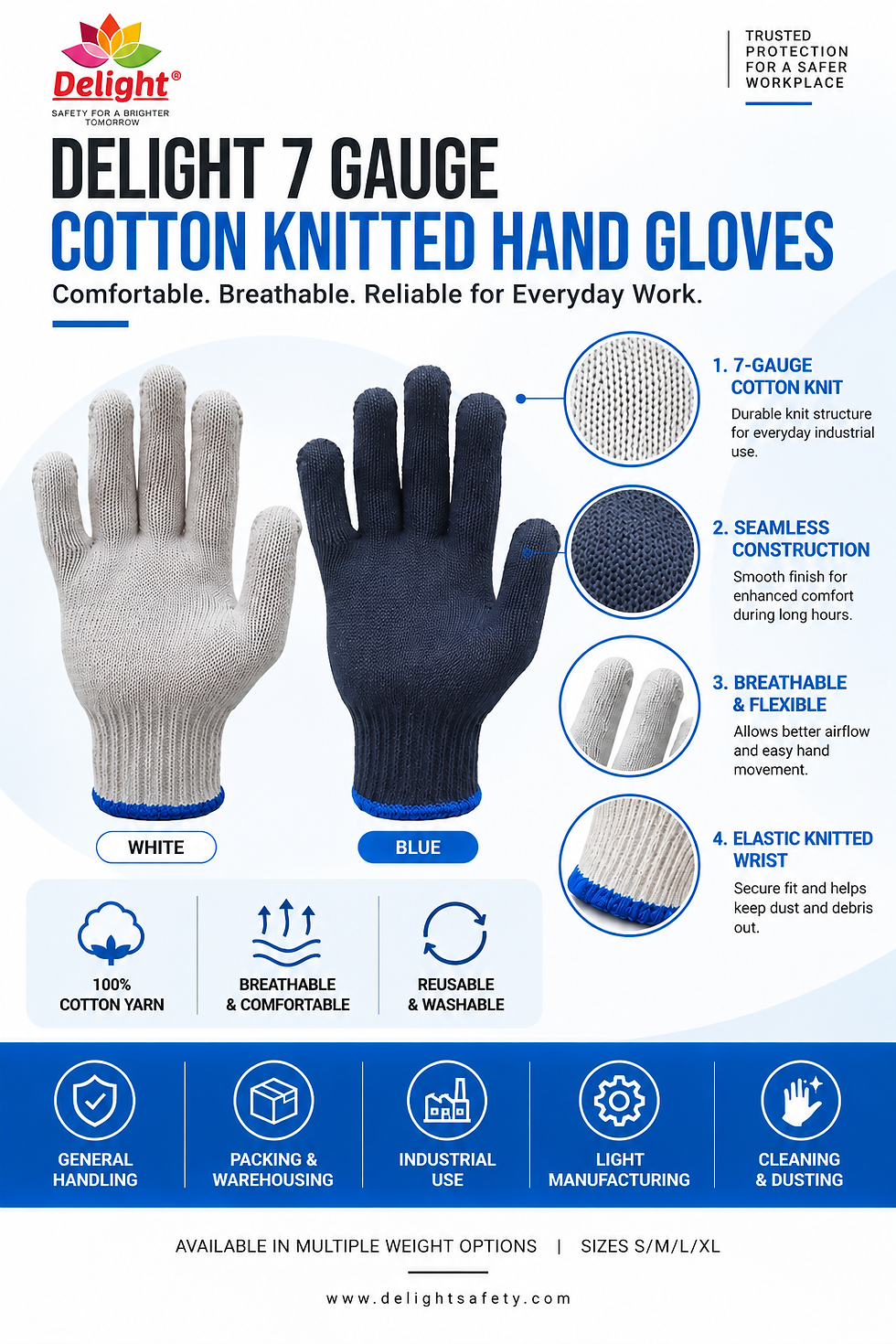
This is the option most people picture when they think of a traditional cotton work glove.
Knitted using a coarser 7-gauge structure, it's commonly selected for general handling, packing, warehousing, sorting, and other everyday industrial applications.
At Delight Safety, the standard 7 gauge range is available in multiple weight options, starting from lighter 35g options and going up to 80g.
That gives buyers flexibility depending on what they need.
A lighter glove may be preferred where comfort and lower bulk are important. A heavier option may be preferred by buyers looking for a glove with more material and a more substantial feel.
Specifications
7 Gauge · Cotton yarn · Seamless knitted construction · 35g, 40g, 50g, 60g, 70g and 80g options · Knit wrist · White or Blue · Reusable and washable with appropriate care
7 Gauge 12-Inch Cotton Knitted Gloves — same idea, more length

The 12-inch version is based on the same basic concept but provides more glove length than a standard wrist-length option.
That can make sense when the user prefers additional coverage around the wrist and lower arm during suitable handling tasks.
For example, teams handling sacks, cartons, crates, or rough dry materials may prefer a longer glove because the standard-length version simply covers less of the arm.
The available weight range for this model starts higher, from 60g and goes up to 100g.
Specifications
7 Gauge · 12-Inch Length · Cotton yarn · Seamless knitted construction · 60g, 70g, 80g, 90g and 100g options · Extended knitted cuff · White or Blue · Reusable and washable with appropriate care
The additional length should not be confused with specialised hazard protection. It simply provides more physical coverage than the standard-length model.
10 Gauge Cotton Knitted Gloves — the finer option

The 10 gauge cotton knitted glove is the finer and lighter option in the range.
Compared with a coarser 7 gauge construction, the knit is finer and can give the user a closer feel around the hand.
That can be useful for suitable handling tasks where workers prefer a lighter glove and more tactile interaction with the material they're handling.
At Delight Safety, the 10 gauge range is available in 35g, 40g, and 50g options.
Specifications
10 Gauge · Cotton yarn · Seamless knitted construction · 35g, 40g and 50g options · Knit wrist · White or Blue · Reusable and washable with appropriate care
Putting all three side by side
Feature | 7 Gauge Standard | 7 Gauge 12-Inch | 10 Gauge |
Gauge | 7 Gauge | 7 Gauge | 10 Gauge |
Length | Standard | 12 Inch | Standard |
Weight options | 35g–80g | 60g–100g | 35g–50g |
Knit structure | Coarser | Coarser | Finer |
Cuff | Knit wrist | Extended knitted length | Knit wrist |
Common buyer preference | General handling | Additional length preference | Lighter and finer handling |
Colours | White, Blue | White, Blue | White, Blue |
Which one should you choose?
For most everyday packing, warehousing, sorting, and general handling work, the standard 7 gauge glove is usually the natural starting point.
If you prefer additional glove length, the 12-inch version is worth considering.
If the task is lighter and you want a finer knitted construction with a closer feel, the 10 gauge option may make more sense.
What actually moves the price?
There isn't one universal cotton gloves price.
And honestly, when someone asks for "the price of cotton hand gloves" without giving a specification or quantity, there isn't much a supplier can quote accurately.
The biggest factors are usually the following.
Gauge
Different knitting constructions can affect material and manufacturing requirements.
Weight
This is a major one.
A 35g cotton glove and a 100g extended-length glove are very different products in terms of material quantity.
Length
A 12-inch glove requires more material than a standard-length glove.
Quantity
Bulk cotton gloves orders, wholesale requirements, and recurring distributor orders are commercially different from a small trial order.
Customisation
Requirements such as:
Specific sizes
Weight preferences
Colour requirements
Logo printing
Branding
may affect the production requirement and quotation.
Freight and taxes
If you're comparing quotations from different cotton gloves suppliers, it is worth confirming whether the price includes:
GST
Freight
Packaging
Other applicable charges
A useful buying tip
Don't compare cotton knitted gloves only by the per-pair price.
Check the gauge, weight, length, material, and construction first.
Otherwise, you may think you're comparing two identical products when you're actually comparing completely different specifications.
For exact pricing and current availability, buyers can share the required model, weight, quantity, and delivery location.
Call/WhatsApp: +91-8740977703
How to choose the right cotton glove for your floor
A few questions usually settle it quickly.
Is the job general handling or lighter handling?
For general packing, warehousing, sorting, and everyday floor work, the standard 7 gauge glove is often the first option to consider.
For lighter tasks where a finer knitted construction is preferred, the 10 gauge option may be more suitable.
Does additional glove length matter?
If you prefer more coverage around the wrist and lower arm, the 12-inch option provides more length than the standard glove.
How much wear is the glove expected to handle?
Weight is worth considering.
Heavier options contain more material, while lighter options may feel less bulky.
The right choice depends on the nature of the work and how often the gloves are expected to be replaced.
Is colour important?
White and Blue are available across the range.
Some buyers use different colours for operational reasons, while others simply choose the colour that works best for their workplace environment.
Where cotton knitted gloves are commonly used
Cotton knitted gloves are used across a surprisingly wide range of workplaces.
Warehousing and logistics teams use them for picking, packing, sorting, and suitable dry handling.
Packaging and FMCG operations may use them for repetitive handling where comfort through a full shift matters.
General manufacturing units may use them for suitable light assembly and routine material handling.
Small workshops and industrial operations often keep cotton hand gloves available because they're simple, comfortable, and useful for a broad range of everyday dry tasks.
They are also commonly searched for by buyers looking for:
Cotton gloves for warehouse workers
Cotton gloves for packing work
Industrial cotton gloves
Factory hand gloves
Cotton handling gloves
Hosiery gloves for industrial use
Bulk cotton hand gloves
Cotton knitted gloves wholesale
Across India, industrial demand for cotton gloves comes from warehouses, factories, distributors, logistics companies, packaging operations, and other workplaces where a simple breathable glove is more appropriate than a specialist coated or cut-resistant option.
Cotton or polyester knitted gloves — which should you actually buy?
We get this question regularly, especially from buyers who are trying to decide which glove will make more sense over repeated use.
Cotton and polyester gloves can overlap in some applications, but they're different materials and shouldn't be treated as identical.
Cotton is commonly selected by buyers who prioritise comfort and breathability.
Our polyester knitted gloves may be preferred by buyers looking for different material characteristics, including shape retention and drying behaviour.
The right choice depends on:
The application
Frequency of use
Washing and reuse practices
Budget
Worker comfort preferences
Required glove characteristics
If budget and comfort are the main deciding factors, cotton may be the more practical option for your requirement.
If you are evaluating repeated washing and long-term reuse, it is worth comparing both categories based on the exact product specifications.
Mistakes we see buyers make
Expecting grip from a plain cotton knit
A plain cotton knitted glove is not the same as a dotted or coated glove.
If grip is important, evaluate a glove designed for that requirement.
Comparing prices without checking the specification
A 7 gauge glove and a 10 gauge glove are not identical.
A 35g glove and a 100g glove are not identical either.
Always compare:
Gauge
Weight
Length
Material
Construction
before comparing prices.
Buying the lightest glove purely to reduce upfront cost
The lowest initial purchase price is not always the lowest long-term cost.
Replacement frequency and suitability for the actual work should also be considered.
Using plain cotton gloves for sharp materials
Plain cotton knitted gloves should not be treated as cut-resistant gloves.
Where cut hazards are present, select a glove specifically designed and rated for the required application.
Using cotton knitted gloves for significant oil, chemical, or wet exposure
Plain cotton is not automatically suitable for these applications.
Glove selection should always be based on the specific workplace hazard.
Care and maintenance
Cotton knitted gloves can be washed and reused where appropriate, but like any work glove, they will eventually wear out.
General care practices include:
Using suitable mild washing methods
Avoiding unnecessarily harsh treatment
Allowing gloves to dry properly
Storing them in a clean and dry location
Checking for thinning, tears, or other damage before reuse
How long a glove lasts depends on the type of work, how frequently it is worn, washing practices, and the conditions it is exposed to.
Once a glove is significantly worn or damaged, it should be replaced rather than pushed beyond its useful condition.
Questions people ask us
What are cotton knitted gloves?
Cotton knitted gloves are seamless gloves made from cotton yarn. They are commonly used for suitable dry handling, packing, warehousing, sorting, dusting, and general industrial work.
Are cotton hand gloves and cotton knitted gloves the same?
The terms are often used interchangeably. However, product specifications can vary between manufacturers, so buyers should confirm the actual material, gauge, weight, and construction.
What are cotton knitted gloves used for?
They are commonly used for dry handling, packing, sorting, warehousing, dusting, and other suitable general-purpose industrial tasks.
What's the difference between 7 gauge and 10 gauge cotton gloves?
A 7 gauge glove has a coarser knitted structure, while a 10 gauge glove has a finer knitted structure and may provide a lighter feel.
Which model provides additional wrist and lower-arm coverage?
The 7 gauge 12-inch option provides more glove length than the standard models.
Are cotton knitted gloves reusable?
Yes, they can be reused where they remain in suitable condition and reuse is appropriate for the application.
Are cotton knitted gloves washable?
Yes, they can generally be washed with suitable care. The condition of the glove should be checked before reuse.
What weight options do you offer?
The 7 gauge standard range is available in 35g, 40g, 50g, 60g, 70g, and 80g options.
The 7 gauge 12-inch range is available in 60g, 70g, 80g, 90g, and 100g options.
The 10 gauge range is available in 35g, 40g, and 50g options.
What colours are available?
White and Blue are available across the range discussed in this guide.
How much do cotton knitted gloves cost?
Pricing depends on the model, gauge, weight, glove length, quantity, and delivery requirements.
For an accurate quotation, it is best to share your required specification and expected order quantity.
Do cotton knitted gloves provide grip?
Plain cotton knitted gloves provide the natural surface characteristics of the knitted fabric.
If additional grip is required, a dotted or coated glove may be more appropriate depending on the application.
Can cotton knitted gloves be used for cuts, oil, or chemicals?
Plain cotton knitted gloves should not be relied upon as specialised protection against cuts, oil, chemicals, or other hazards unless a specific product has been designed and rated for that purpose.
Cotton or polyester — which should I buy?
It depends on the application, expected reuse, worker preferences, and the material characteristics you're looking for.
Cotton is commonly selected where comfort and breathability are important, while polyester may be preferred for different material characteristics.
Can cotton gloves be worn as a liner under another glove?
They may be used as a comfort liner in suitable glove systems, provided they do not interfere with the fit or intended function of the outer glove.
Are cotton knitted gloves breathable?
The plain knitted construction allows for good airflow compared with many coated glove constructions, which is one reason cotton gloves are commonly used for suitable long-duration wear.
What sizes are available?
Standard sizing requirements can be discussed when placing an order.
Where are Delight's cotton knitted gloves made?
Our cotton knitted gloves are manufactured in Bhiwadi, Rajasthan, India.
Do you supply cotton gloves across India?
Yes. We handle PAN India supply enquiries based on product availability, quantity, and logistics requirements.
What's the minimum order quantity?
MOQ can depend on the specific model, weight, customisation requirement, and current stock.
Do you provide GST invoices?
GST requirements can be discussed while requesting a quotation.
Can I get logo printing on these gloves?
Selected branding and logo-printing requirements can be discussed depending on the product and order quantity.
Which cotton glove is best for general warehouse work?
For suitable general warehouse handling, the standard 7 gauge option is often a practical starting point.
The final choice should still depend on what is being handled and whether any specialised workplace hazards are present.
Which cotton glove is better for lighter handling?
The 10 gauge option may be worth considering where a finer knitted construction and lighter feel are preferred.
Do you handle bulk and wholesale cotton glove orders?
Yes. We handle industrial, bulk, wholesale, distributor, and recurring order enquiries based on the required specification and quantity.
Do you ship outside India?
Export enquiries can be discussed based on the destination, product requirement, quantity, and logistics requirements.
A few other guides you might find useful
Cotton Dotted Gloves: Everything You Need to Know Before You Buy
Polyester Knitted Gloves: Everything You Need to Know Before You Buy
Nitrile Palm Coated Gloves: Everything You Need to Know Before You Buy
Latex Coated Gloves: Everything You Need to Know Before You Buy
7 Costly Mistakes Indian Workers Make When Selecting Safety Gloves
Where to buy cotton knitted gloves
Delight Safety offers cotton knitted gloves in multiple configurations, including:
7 Gauge standard gloves
7 Gauge 12-inch gloves
10 Gauge gloves
White and Blue colour options
Multiple weight options
We work with factories, warehouses, industrial users, distributors, dealers, wholesalers, and bulk buyers.
For an accurate quotation, it helps to share:
Required model
Gauge
Weight
Colour
Quantity
Delivery location
Intended application
📞 Call/WhatsApp: +91-8740977703
Safety and application note
Product suitability depends on the specific workplace task, hazards, and operating conditions.
Plain cotton knitted gloves are intended for suitable dry handling and general-purpose applications. They should not be relied upon as specialised protection against cuts, chemicals, significant oil or liquid exposure, heat, electrical hazards, impact hazards, or other workplace risks unless the specific glove has been designed, tested, and rated for the relevant purpose.
Employers and users should select hand protection based on the hazards present in the workplace and applicable safety requirements.
Bottom line
Cotton knitted gloves aren't trying to be a specialist product.
They're the everyday option for workplaces that need something breathable, comfortable, and practical for suitable dry handling.
Which one fits best depends on how your team works.
The standard 7 gauge glove is the natural starting point for general handling, packing, warehousing, and routine industrial work.
The 7 gauge 12-inch version makes sense when additional glove length is preferred.
The finer 10 gauge option may be more suitable when workers prefer a lighter glove and a finer knitted feel.
The important thing is not to buy cotton gloves simply because they're inexpensive.
Buy them because they're the right category for the job.
And if the work involves demanding grip requirements, sharp material, oil, chemicals, wet handling, or another specialised hazard, it's worth looking at a glove specifically designed for that application.
Written by Mahesh Prakash, Head of Marketing at Delight Safety, with 13+ years of experience.
Tags: Cotton Knitted Gloves · Cotton Hand Gloves · Cotton Knit Gloves · Industrial Cotton Gloves · Cotton Work Gloves · Hosiery Gloves · Hosiery Cotton Gloves · Cotton Gloves Manufacturer India · Cotton Gloves Supplier India · Cotton Gloves Wholesale · Bulk Cotton Gloves · Industrial Hand Gloves · 7 Gauge Cotton Gloves · 10 Gauge Cotton Gloves · 12 Inch Cotton Gloves · Warehouse Gloves · Packing Gloves · Cotton Handling Gloves · Cotton Gloves for Factories · Industrial Hand Protection · PPE Gloves · Workplace Safety


Comments