
Polyester Knitted Gloves: Everything You Need to Know Before You Buy

If you've ever watched someone on an assembly line pull off a heavy coated glove just to feel a part properly, you already understand why polyester knitted gloves exist. They're the simplest gloves we make — no coating, no PVC dots, nothing dipped on top — just knitted polyester yarn shaped into a seamless glove. People call them a few different things depending on where they're from: polyester liner gloves, polyester hand gloves, nylon-polyester knitted gloves, poly knit gloves, or just "knit liners." All the same product, more or less.
We manufacture three versions at Delight Safety, out of our facility in Bhiwadi, Rajasthan: MPK1361 (13 gauge, standard cuff, White or Black), MNK30 (10 gauge, standard cuff, White or Black), and MPK13-61(WL40) (13 gauge with a 12-inch extended cuff, also White or Black). All three are reusable, washable, and available across a few different weight options depending on which one you pick. We ship these across India and handle export orders too — the pricing moves around a bit depending on gauge, weight, and how many pieces you're ordering, which we'll get into further down.
Quick answer, if you're in a hurry: polyester knitted gloves are lightweight, seamless knit gloves worn either on their own for light dry handling, or as a comfort liner underneath something heavier — a coated glove, a dotted glove, a cut-resistant glove. They're not built to grip anything slippery and they won't protect against cuts, oil, or chemicals. If your team needs any of those, this isn't the right glove — jump to our dotted or coated ranges instead. If what you actually need is comfort, breathability, and a glove that doesn't get in the way of dexterity, keep reading.
A quick snapshot of the range
Attribute | Details |
Also called | Polyester liner gloves, polyester hand gloves, poly knit gloves, nylon-polyester knitted gloves |
Material | Polyester yarn (MPK13-61 is a nylon/polyester blend) |
Gauge | 10 Gauge or 13 Gauge |
Colors | White, Black |
Weight range | 20g to 60g, depending on model |
Cuff | Standard elastic wrist, or a 12-inch extended cuff |
Construction | Seamless knit, no coating or dotting |
Reusable/washable | Yes |
Made by | Delight Safety, Bhiwadi, Rajasthan |
Ships to | PAN India, plus export |
Good for | Assembly, inspection, packing, warehousing, or wearing under a heavier glove |
Not good for | Grip on smooth material, cuts, chemicals, wet or oily handling |
So what actually is a polyester knitted glove?
It's a knitted glove, plain and simple — no coating, no dots, just polyester yarn worked into shape on a hosiery knitting machine. The gauge number tells you how tightly it's knit: a 13-gauge glove is finer, thinner, and closer-fitting than a 10-gauge one, which is knit a bit chunkier and holds up better to wear. Neither is "better" outright — it depends on whether your team needs dexterity or durability more.
Where these gloves earn their keep is in two very different jobs. One, as a standalone glove for anything dry and low-hazard — sorting parts, packing boxes, inspecting components, general assembly work where you mostly just need clean hands and decent finger feel. Two — and this one surprises people who haven't bought industrial gloves before — as a liner glove. A lot of buyers put a thin polyester knit glove on first and then pull a coated or dotted glove over it. It soaks up sweat, makes the outer glove more comfortable for an eight-hour shift, and honestly extends the life of the more expensive glove sitting on top of it.
A fair question we get: why polyester instead of plain cotton, if they're doing basically the same job? Cotton is cheaper, sure, and it's perfectly fine for a lot of applications. But polyester holds its shape better wash after wash — cotton tends to stretch and go a bit baggy after repeated use, while polyester keeps its snug fit longer and dries faster too. It's also close enough to nylon in feel that the two get lumped together a lot, which is part of why our MPK13-61(WL40) is sold as a nylon/polyester blend rather than pure polyester.
Why not just get a coated glove instead?
Fair question, and one we hear a lot from buyers who are used to thinking of "glove" as meaning "coated glove." Here's the honest trade-off.
A plain polyester knit is light, cheap, and breathable — you can wear it all shift and barely notice it's there. What it won't do is grip anything smooth or slippery, and it offers zero protection against cuts, oil, or chemicals. A coated glove — nitrile, latex, or PU — solves the grip and resistance problem completely, but it costs more, it's heavier, and it doesn't breathe nearly as well. Our dotted gloves sit somewhere in between, adding grip only where the palm needs it while keeping most of the fabric open.
If your team's work is genuinely dry and low-risk — assembly, inspection, general handling — a polyester knit is usually the right call and honestly the more comfortable one. If hands are gripping something slick, or there's any risk of cuts, oil, or moisture, you want a different glove entirely, and we'd rather tell you that now than sell you the wrong thing.
How polyester knit compares against everything else we make
Glove Type | Grip on dry material | Cut resistance | Breathability | Where it's used |
Polyester Knitted (plain) | Weak | None | Very high | Liner use, light handling, assembly, inspection |
Good | None | High | Same fabric, with PVC dots for grip | |
Strong | None (unless combined) | Moderate | Oily or greasy handling, metal parts | |
Strong | None (unless combined) | High | Precision assembly, electronics | |
Strong | None | Moderate | Wet handling, agriculture | |
Varies | Yes | Moderate | Sheet metal, glass, sharp edges | |
Plain Cotton Knitted | Weak | None | Very high | Light dusting, low-grip liner use |
We also get asked how polyester knit stacks up against our cotton knitted range — more on that a bit further down, since it comes up often enough to deserve its own section.
The three gloves we make
MPK1361 — the everyday 13-gauge liner

This is our finest knit, and the one most people end up buying if they're not sure where to start. Because it's knit so fine, you get real fingertip sensitivity through it — close to bare-hand, which matters if your team is doing inspection or handling small components where feel actually matters. It's also the coolest glove in the range to wear, since the fabric is thin enough to breathe well over a full shift.
Specs: Model MPK1361-W / MPK1361-B · 13 Gauge · Polyester · Weight options 20g, 25g, 30g, 35g, 40g · Elastic knit wrist · Seamless construction · White or Black · Reusable and washable
MNK30 — the tougher 10-gauge option

Same idea, knit a bit heavier. The 10-gauge structure means it's not quite as dexterous as the MPK1361, but it survives more handling cycles before it starts to show wear — which matters more than you'd think if your gloves are going through a lot of daily use. If your team burns through gloves fast and you'd rather buy fewer, heavier pairs than more, thinner ones, this is usually the better economics.
Specs: Model MNK30-W / MNK30-B · 10 Gauge · Polyester · Weight options 30g, 40g, 50g, 55g, 60g · Elastic knit wrist · Seamless construction · White or Black · Reusable and washable
MPK13-61(WL40) — the 12-inch one
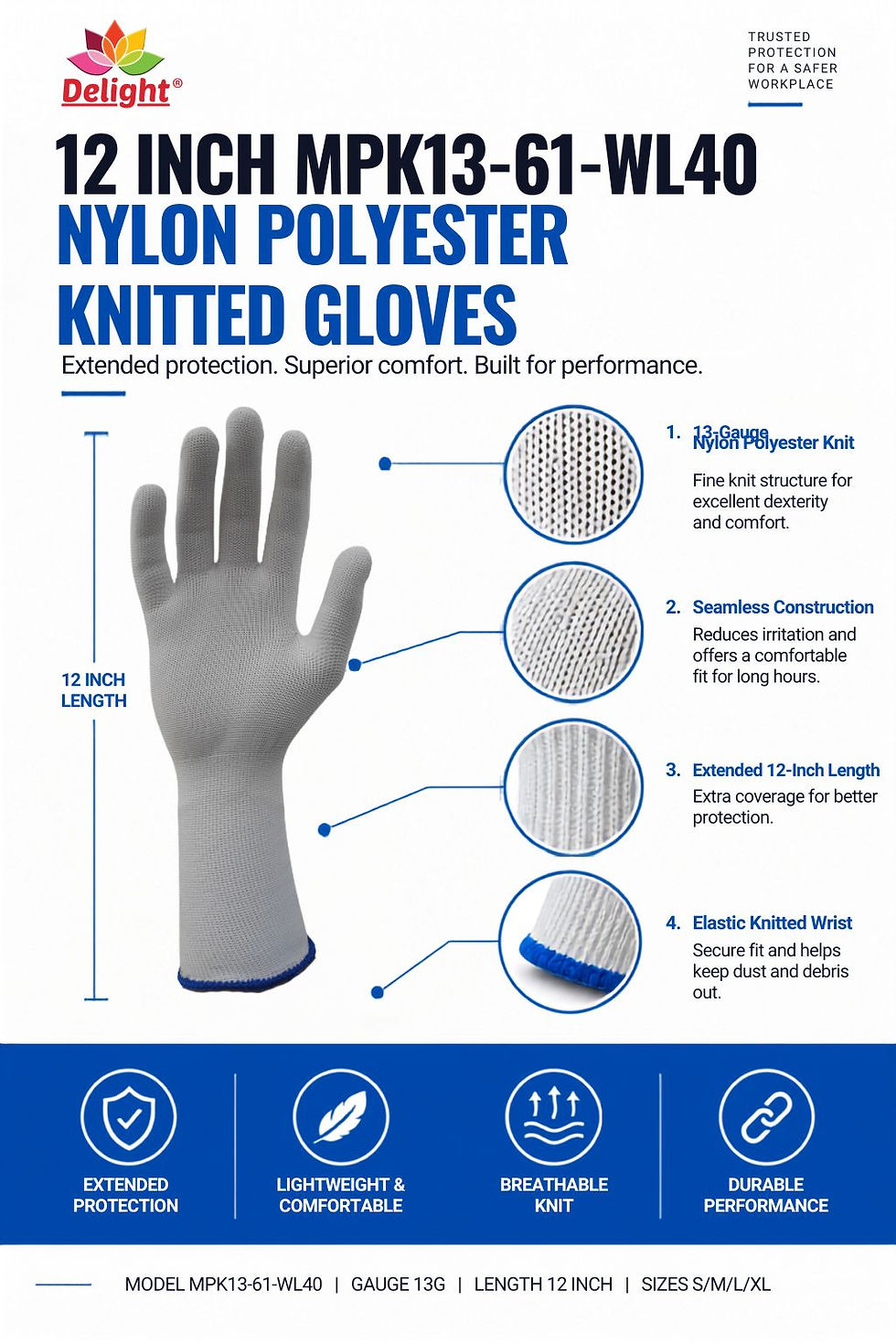
Basically the MPK1361 with a longer arm. The extended cuff runs 12 inches up the forearm instead of stopping at the wrist, which matters if your team's hands and forearms are both exposed during the work — inspecting near machinery, handling that brushes against the arm, or just wanting dust kept out further up. We list it as a nylon/polyester knit rather than pure polyester, since at this gauge the two fibers behave similarly enough that it's sold as a blend.
Specs: Model MPK13-61(WL40) · 13 Gauge · Nylon/Polyester blend · 12-inch length · Extended elastic cuff · Seamless construction · White or Black · Reusable and washable
Putting all three side by side
Feature | MPK1361 | MNK30 | MPK13-61(WL40) |
Gauge | 13 Gauge | 10 Gauge | 13 Gauge |
Material | Polyester | Polyester | Nylon/Polyester |
Length | Standard | Standard | 12 Inch |
Weight options | 20g–40g | 30g–60g | Matched to standard 13G range |
Best for | Dexterity, inspection | Durability, general handling | Wrist & forearm coverage |
Colors | White, Black | White, Black | White, Black |
For actual pricing and current stock, it's genuinely faster to just call or WhatsApp us — rates move around with weight and quantity, so we'd rather quote you directly than post a number that's out of date by the time you read it. Call/WhatsApp: +91-8740977703
What actually moves the price
We don't keep a fixed price list for these, and there's a reason for that — too many variables change the math. Gauge is one (10-gauge uses more yarn than 13-gauge). Weight is another — a 20g glove and a 60g glove are barely the same category of product once you factor in raw material. Then there's cuff length, color, and obviously how many you're ordering. A trial batch of a few dozen pairs and a recurring order of a few thousand aren't going to land anywhere near the same per-piece rate.
If you're comparing quotes from a few suppliers, it's worth asking each one the boring-but-important questions: does this number include GST and freight, can you actually issue a GST invoice, and what's your minimum order quantity at this price. Tell us your model, weight, and rough quantity and we'll send back a number that actually applies to your order.
Picking the right one
A handful of questions usually settle it:
Does the work need real fingertip feel, or is it more general handling? Inspection and small-parts work point you toward the finer 13-gauge MPK1361. Everyday handling where a bit more knit thickness doesn't matter — the 10-gauge MNK30 does the job just as well, and probably lasts longer.
Are you replacing gloves often enough that durability matters more than dexterity? That's the MNK30 again — the thicker knit just holds up better over repeated use.
Does the forearm need covering too, not just the hand? Then it's the MPK13-61(WL40), no real substitute for the extra length.
Is this glove going on bare hands, or under another glove? If it's a liner, go with the thinner MPK1361 — a thick liner under an already-bulky coated glove just makes the whole thing awkward to wear.
And color — White or Black is mostly a preference thing, though a few of our customers use it to tell shifts or departments apart at a glance, and Black does hide everyday grime better over a long shift.
Where these gloves actually get used
Electronics and precision assembly lean on these heavily — small components, wiring, anything where you need to actually feel what your fingers are doing. General manufacturing floors use them for machine tending and sorting where nothing hazardous is involved. Warehousing and logistics teams use them for light picking and packing, or layer them under a dotted glove for comfort. Automotive and metal-parts handling often pairs a polyester liner under a coated or cut-resistant outer glove. And honestly, anywhere quality control or inspection happens, this is usually the glove on hand.
We ship into industrial clusters across Rajasthan, Gujarat, Maharashtra, Tamil Nadu, and the NCR belt regularly — wherever factories and warehouses need a comfortable, inexpensive everyday glove that doesn't slow people down.
Polyester or cotton knitted — which one do you actually need?
Buyers comparing our cotton knitted gloves against this range ask us this constantly, so here's the straight answer.
Cotton is cheaper and just as breathable, and for basic dusting or low-grip liner use, it does the job fine. The catch is that cotton stretches out of shape faster once you start washing and reusing it repeatedly, and it holds onto moisture a bit longer than polyester does.
Polyester costs a little more but keeps its fit through more wash cycles and dries quicker. If you're reordering gloves often and want each batch to actually hold its shape, polyester tends to work out better over time, even with the slightly higher upfront cost.
If budget is genuinely the deciding factor and gloves are treated as near-disposable, cotton's still a reasonable choice. If you want something that lasts a bit longer per pair, go polyester. And if you're not sure, just tell us how often you're washing and reusing them and we'll point you the right way.
Mistakes we see buyers make
Expecting grip out of a plain knit glove — it just doesn't have any beyond the natural texture of the fabric. If grip matters, you want our dotted gloves instead, not this.
Comparing prices across suppliers without checking gauge first. A 10-gauge glove and a 13-gauge glove use different amounts of yarn and feel completely different in the hand — comparing their prices side by side without matching gauge is comparing two different products.
Skipping cuff length when the job actually needs forearm coverage. If hands and lower arms are both exposed, the standard-length gloves won't cut it — that's what the 12-inch MPK13-61(WL40) is for.
Going straight for the cheapest, lightest weight option. It wears out faster, and over a few months of reordering, that "savings" often disappears.
And using these for anything involving cuts, oil, or chemicals — a plain polyester knit was never built for that, and no amount of wishful thinking changes what the fabric can actually do.
Keeping them in good shape
Wash by hand with mild soap in lukewarm water if you can — polyester takes washing well, but harsh detergents and repeated hot machine washes will wear out the elastic cuff faster than normal use would. Let them air dry away from direct heat; polyester dries quickly on its own, so there's no real need to rush it. Store them somewhere clean and away from anything sharp that could snag the knit. Check the fingertips and palms now and then for thinning — once the fabric wears through, the comfort advantage that made you buy these in the first place is gone. And when they do wear out, just replace them. These are meant to be a high-turnover, low-cost item, not something you push past its useful life.
Questions people ask us
What exactly is a polyester knitted glove?
A seamless, lightweight glove knitted from polyester yarn — no coating, no dots. Worn either on its own for light dry handling, or under a heavier glove as a comfort liner.
What's the real difference between 10 gauge and 13 gauge?
Gauge is knit density. 10 gauge is thicker and more durable; 13 gauge is finer, thinner, and better for tasks that need dexterity. Neither is objectively better — it depends what you're doing.
Is a polyester knitted glove the same thing as a nylon one?
Close enough that people often treat them as interchangeable. Both are synthetic knits with similar comfort and durability, which is why our 12-inch model is sold as a nylon/polyester blend.
Which model has forearm coverage?
The MPK13-61(WL40). Its 12-inch cuff runs up past the wrist, which the other two standard-length models don't offer.
Can I wash and reuse these?
Yes, all three are meant to be reused. Hand wash with mild soap rather than harsh detergent or repeated hot machine cycles, and they'll last a lot longer.
What weights are available?
MPK1361 comes in 20g, 25g, 30g, 35g, and 40g. MNK30 comes in 30g, 40g, 50g, 55g, and 60g.
What colors do you offer?
White and Black across all three models.
How much do these cost?
Depends on gauge, weight, cuff length, color, and quantity — we quote based on your actual order rather than posting a fixed price, since the numbers genuinely move. Send us your requirement and we'll get back with a real number.
Can these protect against cuts or chemicals?
No, not at all. For cuts, look at our cut level gloves. For oil, chemicals, or wet handling, you want a nitrile, latex, or PU coated glove instead.
Do polyester knit gloves grip anything?
Barely — just whatever texture the knit naturally has. If grip matters, our polyester dotted gloves use the same fabric with PVC dots added on.
Polyester or cotton — which is actually better?
Neither, universally. Polyester holds its shape and dries faster over repeated washing; cotton's cheaper upfront. It comes down to your budget and how hard you're washing and reusing them.
Can I wear these under a heavier glove?
Yes, that's one of the most common ways people use them. The thin MPK1361 works especially well as a liner under a coated or dotted glove.
Are they actually breathable, or is that just marketing?
Genuinely breathable — it's a plain open knit with nothing dipped or coated on top, so it's one of the more comfortable options for long shifts, especially in warmer environments.
Will these keep hands cool?
They help more than a coated glove would, since air moves through the knit and the fabric wicks sweat. That said, it's comfort through breathability, not active cooling.
What sizes are available?
Standard glove sizing (S/M/L/XL) is available — let us know what your team needs when you place the order.
How do I know your gloves are actually made in India?
We're based in Bhiwadi, Rajasthan, and manufacture there directly. Happy to share more detail on request if that matters for your procurement.
What's your minimum order quantity?
It depends on the model, weight, and what's currently in stock. We handle everything from small trial orders to large recurring distributor orders — tell us your quantity and we'll confirm.
Do you provide GST invoices?
Yes. If GST or freight affects your budgeting, mention it upfront when you ask for a quote so we can factor it in.
Can I get my logo printed on these?
Yes, on request — size, weight, color, and logo printing are all available, which a lot of our distributor customers use for branded gloves.
Which one should I buy for inspection work?
The MPK1361. It's the finest knit we make, so it keeps fingertip sensitivity closest to bare-hand.
Which one lasts longest?
The MNK30. Its thicker 10-gauge knit holds up to more handling cycles than the finer options.
How many pairs come in a typical bulk order?
Anywhere from a few hundred pairs for a single-site trial to tens of thousands for distributors and export orders. Tell us your expected volume and we'll quote accordingly.
Do you ship outside India?
Yes, we handle export inquiries alongside our PAN India supply. Send us your destination and quantity and we'll work out pricing and logistics.
A few other guides you might find useful
Cotton Dotted Gloves: Everything You Need to Know Before You Buy
Nitrile Palm Coated Gloves: Everything You Need to Know Before You Buy
Latex Coated Gloves: Everything You Need to Know Before You Buy
Types of Cut Liner Gloves: A Complete Guide to Cut-Resistant Hand Protection
7 Costly Mistakes Indian Workers Make When Selecting Safety Gloves
Where to buy
All three gloves — MPK1361, MNK30, and MPK13-61(WL40) — are available in White and Black, with pricing that flexes around gauge, weight, cuff length, and quantity. We work with single-site factories placing small trial orders right through to distributors placing large recurring ones, and we handle both GST-invoiced domestic orders and export inquiries.
📞 Call/WhatsApp: +91-8740977703 🔗 Browse the full polyester knitted glove range → 🔗 Browse 10 Gauge Polyester Gloves → 🔗 Browse 13 Gauge Polyester Gloves → 🔗 Contact us → 🔗 Become a dealer →
Bottom line
These gloves aren't trying to be everything — they're built for the jobs where comfort and dexterity matter more than heavy-duty protection: inspection, assembly, general handling, or sitting quietly under a heavier glove doing the unglamorous work of keeping hands comfortable through a long shift. Which of the three you actually need comes down to how your team works day to day. If you're not sure, just tell us what the job involves and how many you need, and we'll point you to the right one.
Written by Mahesh Prakash, Head of Marketing at Delight Safety, with 13+ years of experience.


Comments